All models are wrong. Some of them can dance.
There's a line attributed to the statistician George Box that I think about more often in the ballroom than I ever expected to: all models are wrong, but some are useful. He was talking about mathematics. He could just as easily have been describing a dance lesson.
A dance lesson is, if you look at it honestly, a parade of models. Frames, centers, circuits, invitations, energies — none of them literally true, all of them attempts to compress something enormously complicated into an idea a body can hold onto while it's busy doing something else. The good teachers know they're handing you a simplification. The great ones know when to take it back.
One of the models I hand people most often is one I learned from Edward Simon, who teaches it early on because it gives people an immediate way to relate to the stimulus of giving or receiving a lead. He calls it the magic triangle, and I'd bet versions of it exist in studios all over the world.
It goes like this: you've got two endpoints — one hand and the other hand — and you've got your lower core. Call that something between your pelvic floor and your belly button, and deep inside your body. Not a point on your skin, front or back, but interior. You can imagine it as the place all of your energy and sense of extension comes from. Those three points make the triangle, and the whole model is one system: they need to talk to one another. If the center moves, the hands move. If the hands move, the center moves. When a leader gives a message, all three points say the same thing.
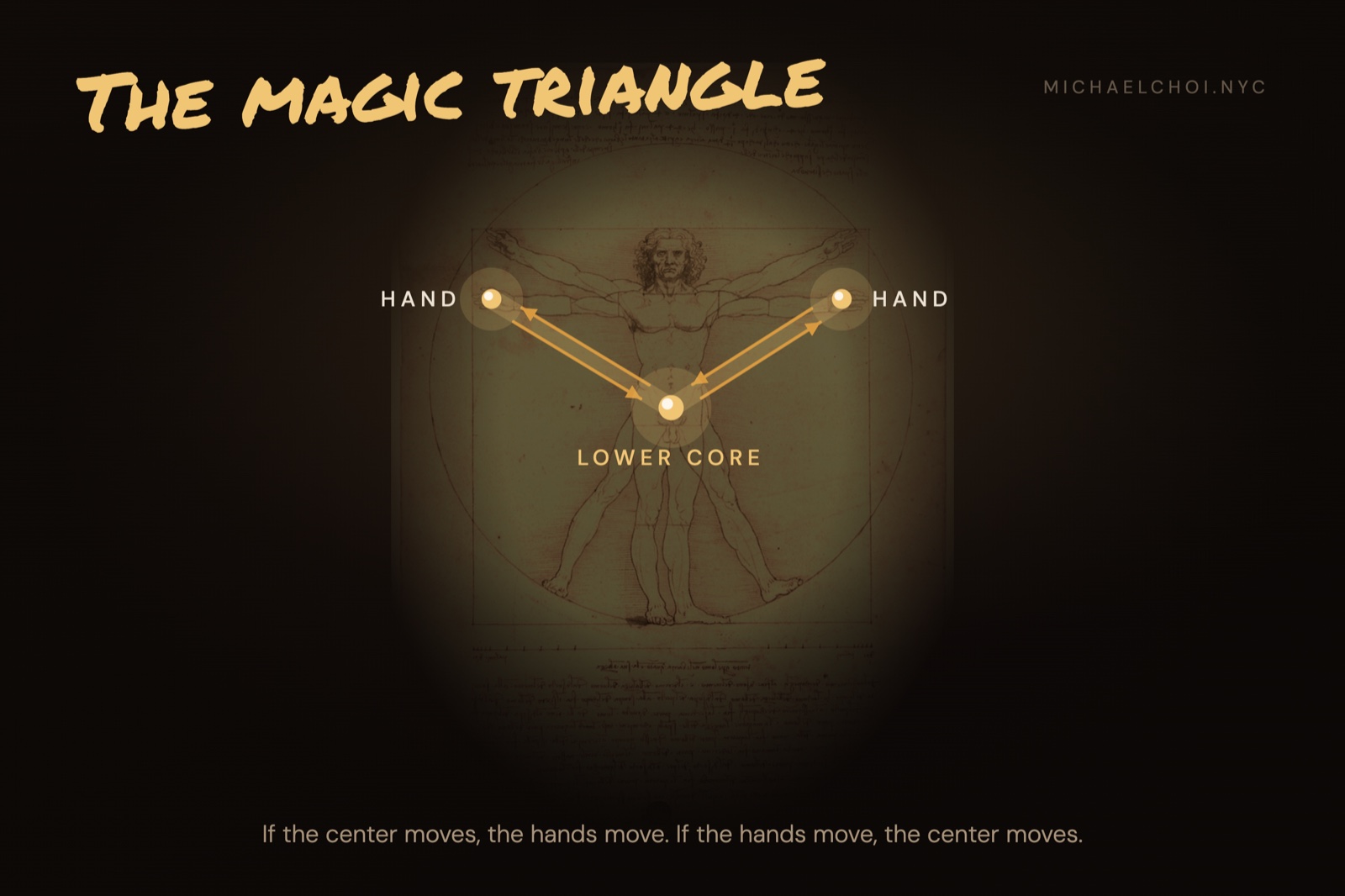
The way we talk about this makes it sound like this is a follower's tool, but it belongs to the leader just as much. Both people are running their own triangle, because on both sides the center and the endpoints have equal impact on what gets communicated.
What the triangle is really protecting is a division of labor that partner dancing depends on. When a leader moves a hand forward or back, that's not transportation — it's an invitation for the follower to use their own legs, supporting and free, to move their own center. It is absolutely up to the follower to move their own body weight. And it is absolutely up to the leader, having extended the invitation, not to overload that system by sending another invitation before the follower's interpretation has had a chance to arrive. Everyone is one hundred percent responsible for moving their own body, and at the same time completely interdependent: when either side doesn't follow through, both suffer. The obligation is not to be correct — correct is always a conditional thing — but to relate to the other person as well as you possibly can.
The triangle should keep working as you take it apart. Hold with one hand instead of two and the system is unbalanced — a slight pressure toward the follower could easily just spin them — yet a dancer who retains their shape funnels that off-center force into a productive direction. Put the partnership in shadow position, where the contact might be a hand on the body and a left hand in a left hand, and those two points carry everything. Reduce it to a single point of contact and that one point should still convey the key information of the lead. Perhaps not everything. But enough. Fewer points of contact don't break the model; they just ask each remaining point to say more.
That only works because of what's happening where nobody is touching. The simplest test I can offer: stand still and move your arms. Your body should not sway. That sounds like nothing and yet it takes tremendous dexterity — the amount of isolation and control in the torso and shoulders, joints mobile, so that the motion of the arms doesn't shake the frame of the body...that's a lot. Our bodies are actually enormously active while appearing still, and it's exactly that ability to retain stillness that connects the arms back to the center. This is what everyone is actually looking for when they talk about wanting connection from a partner. Touch a well-trained dancer with their dancer mode switched on and you can feel every part of their body related to every other part. When that's not switched on, people go hunting for substitutes — leaning their weight away, manufacturing push and pull — physical tells standing in for physical organization.
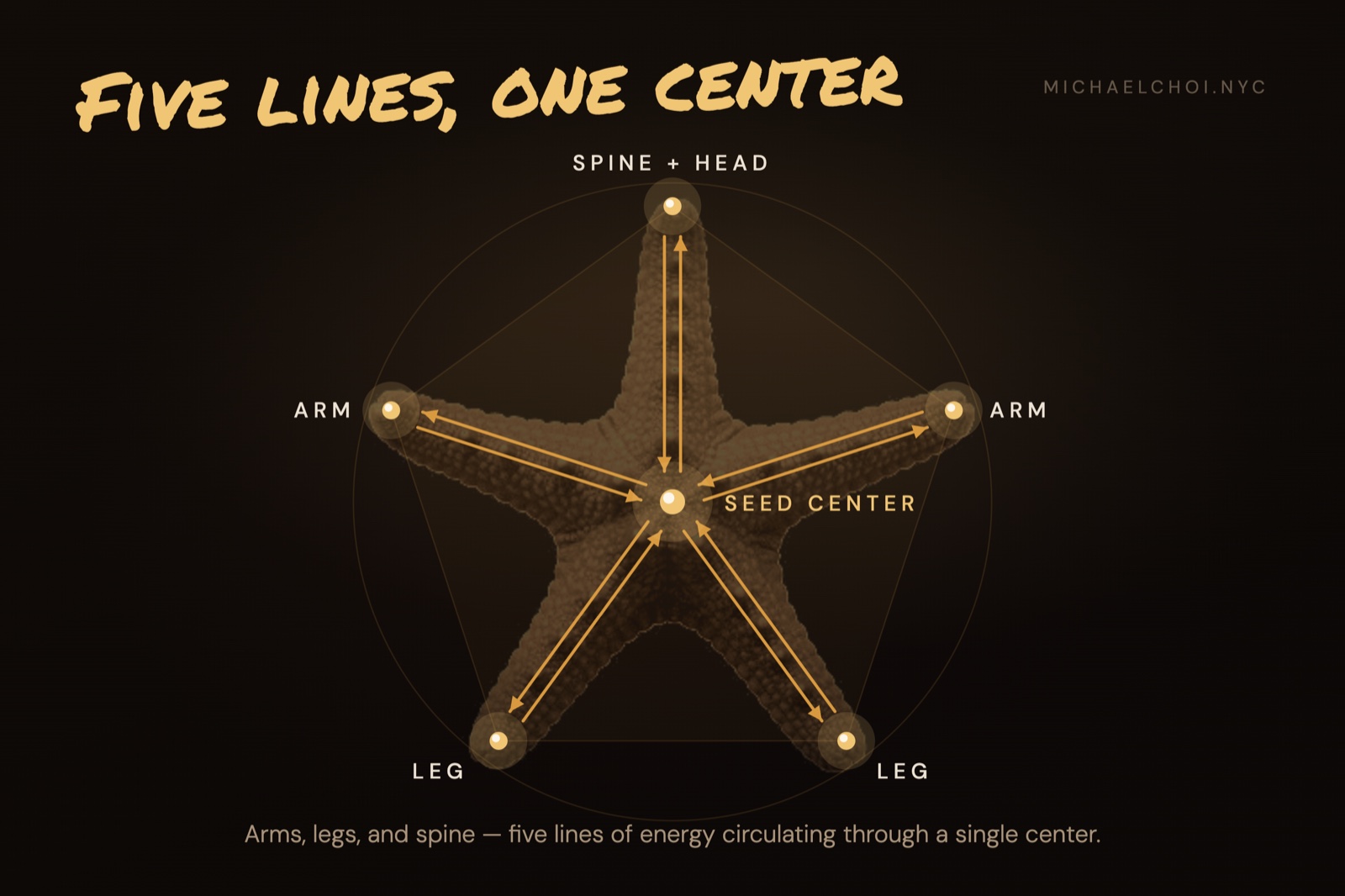
Through Gyrotonic training, I picked up the concepts of the seed center and the fifth line of energy, and a picture I'd always carried privately snapped into focus. I've envisioned the body as a starfish: five limbs — two legs, two arms, and the spine extending up through the neck and head — all meeting in a radial center at the lower core. If you'd like something more human than an echinoderm, Da Vinci's Vitruvian Man will do. Seen that way, the magic triangle isn't an arbitrary geometry at all. It's a selection: three of the starfish's five lines — the two arms and the center they share — chosen simply because that's where partner contact usually lives. Change the hold and you're selecting different lines; the ones nobody is touching are still there, still organized around the same center. Which is why the model degrades so gracefully. The triangle you can feel is drawn on an organization that's there whether or not anyone touches it.
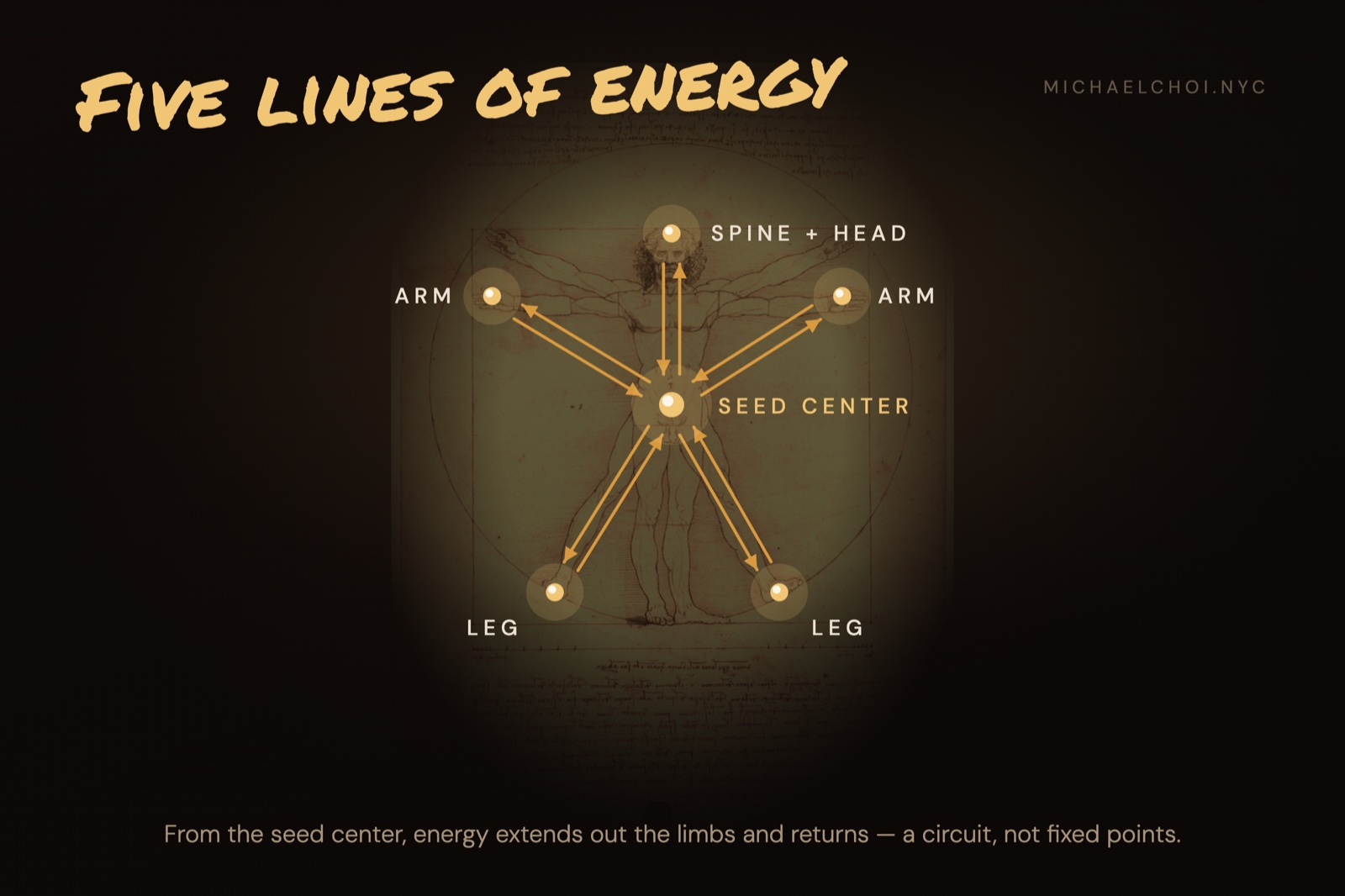
And still: the model is wrong. Its particular wrongness is that it invites people to think of those three points as fixed — pinned in space — when the arms are capable of tremendous flexibility and lyricism that a rigid triangle never suggests. It also stops at the hands, when what's really happening is a circuit: from the floor, up through one partner's feet, legs, and center, through the spine and out the limbs into the other person, through their body, down through their legs, back into the floor. But our puny little human brains are not good at keeping many instructions alive in the body at once. Three points is about the right number. The triangle earns its keep not by being true but by being usable — it's a five-minute explanation that takes years of practice to embody.
The real skill, for the teacher and the dancer both, is noticing the moment a model stops serving you and letting it go. The triangle gave you congruence; when it starts giving you rigidity, say thank you and reach for another wrong, but useful idea. That's not a failure. That's just how models work.
The circuit — the full floor-to-floor loop the triangle abbreviates — deserves its own piece. Soon.